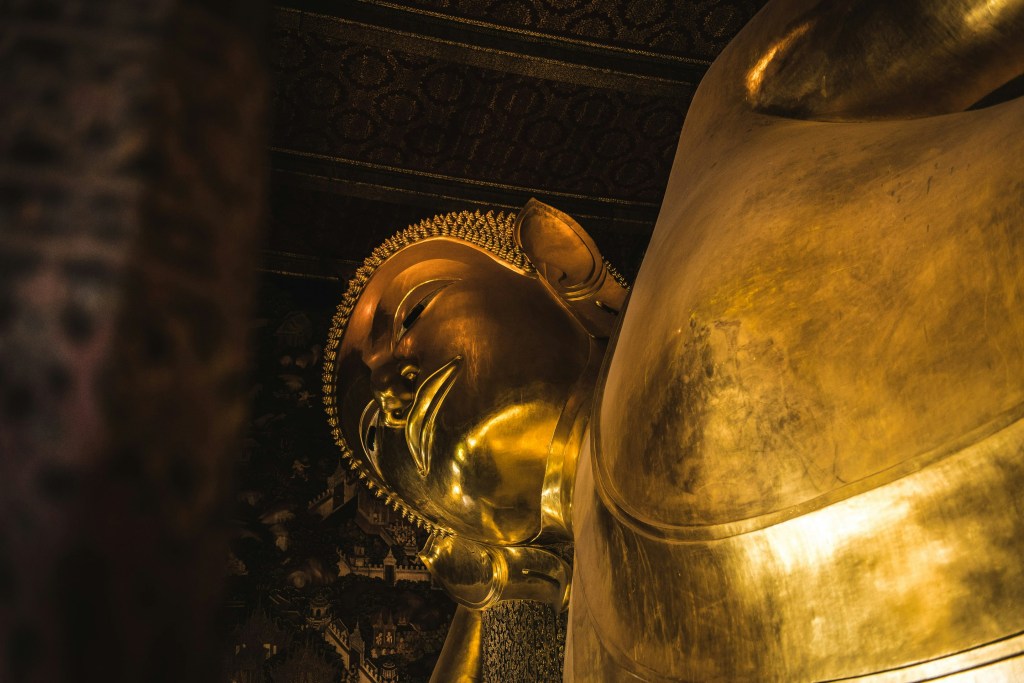
Day#6 sit#22 This is the final sit of this self-retreat focused on the attainment of the immaterial jhanas. Self-retreat means that I put myself in the conditions of a meditation retreat but at home. I still had to go to the grocery store and cook. I kept several conditions that are usually not allowed in intensive retreats such as exercising, talking and writing notes. I kept stretching, jogging, exercising and practicing QiGong. Indeed, I still have a pretty twisted spine bringing lots of health issues. Therefore, I felt I have to compensate the few hours of sitting with physical activity to prevent from falling ill again. In the past, I would sit and sit and sit not caring about the status of the body. As a result, I got severly ill, vascular problems and irreversible joint damages. I learned the lesson. I now sit comfortably and compensate the physical inactivity daily with cardio training, joint opening and stretching. I also kept writing notes to follow the progress and keep track on the conditions allowing certain meditative factors to arise. And, I didn’t cut on helping reagrding the Dhamma meaning that I kept giving talks and replying to questions related to the Buddha’s teachings. I know pretty well that all those exceptions have a direct effect on concentration. They are not helping and sometimes detrimental. Besides from that, I could sit in meditation four times for one hour. I would sometimes lie down as an extra. Typically, I would sit at 4.30 am, 10 am, 3pm and 7pm.
Before starting, if you are not familiar with the jhana meditative absorptions, you can have a look to that post explaining why training in the jhanas can be useful for the spiritual path.
The goal I set for that retreat was to gain mastery over the 5th jhana. As a bit of context, since I started meditation eight years ago, I’ve never had any problem to gain samadhi. I didn’t have to train much to reach the immaterial jhanas- they arose as if my mind knew already how to get there. I’m telling this to warn you not to compare your practice with mine and the time of practice needed to achieve the same results. It depends on the meditator abilties, on past kamma and also in which stage of enlightenment you are in. A sotappana (first stage) has still to deal with the hindrances while an Arahant no longer has to deal with them. S.he is “hindrances-free” all the time and therefore concentration is easier to get.
In the first year of meditation, I would attain the immaterial jhanas at will. Only later did I learn that it was not the case for every meditator and that this ease was most probably due to many past-lives spent as a yogi. For the first four years of my practice, I practiced both samatha and vipassana meditation and for the last four years mostly vipassana. The past year, I would do almost exclusively insight practice. Therefore, I lost the ability to reach the immaterial jhanas rapidly. Lately, since insight is no longer a need, I’ve decided to develop again that capacity to enter the immaterial jhanas but this time, I wanted not only to enter them but to master them. It is described in the Visuddhimagga that mastery is when you can master the entry, absorption and exit and that you can switch between the states at will, and in any order. I already had a «jhana self-retreat» in August and wanted to implement new «mind hacks». Since this last retreat, I was able to reach in a 45 minutes long sit, the 5th jhana on a daily basis while having a full time job and raising a child. I wanted for that retreat to be able to stay in the 5th jhana for about an hour and to really master the entry, absorption and exit. I wanted also to wait until the concentration was strong enough to go to the higher jhanas just for the sake of not getting rusty.
The 5th jhana is officially called in the Pali Canon, the base of infinite space but I’ll keep calling it « 5th jhana » in the following for the sake of conciseness. In a nutshell, when you reach it, you only experience the mind that perceives boundless space. It looks like an infinite black space with nothing in it. No matter and no form can be perceived in it. You are not aware of any sensory-impact. The body is not felt and the physical senses are not experienced as if they were totally inactive.
It took about two and a half days before the concentration would hit hard, stay, and allow you to experiment. Then, I would be able to sit and reach the 5th jhana in a few minutes. Still, I had to start from the fine material jhanas 1 to 4 first. The days after, I would sit, and the 5th jhana would be there almost right away. Then, it would just be trying to maintain it, trying some mind shifts and changes of perceptions to deepen the state, and adjusting mental activities. At some point, I got confused. I lost the recipe to get there only to realize two sits later that because I could reach the state easily, I wouldn’t notice that I would be in the state already. Somehow, the mind got so inured to it that it was as if it was the default mode that I could no longer « see » that I was already in it. Confusion passed, and the last days were about deepening the state, making it last, and making it more stable.
This doesn’t help many of those meditators trying to explore that land. What could I say about what I’ve learned that could be helpful? First, I learned that at the beginning of the retreat, it was quite important to stay for a long time in the 4th jhana first before jumping to the 5th. Why? Because then, all the jhana factors needed to move to the 5th would be already fully developed and stable. Note that when spending lots of time in the 4th jhana, visions and visits from beings are very likely to occur. If you want to proceed to the first immaterial jhana, just ignore them; don’t bother, or you will lose time and drive you away from your goal.
Second, at this point, it is very likely that the nimitta of the breath will be present if anapanasati is your practice. In my own experience, the nimitta takes the form of a light which is either purple, white or cyan depending on the depth of concentration. It might be highly dynamic relative to your remaining mind activities. At this point, it is important to completely ignore it as if looking but not looking, as if looking through a window. While looking through a window, you don’t pay attention to the glass and the specifics of the glass. Somehow, you have to « look » through the nimitta. You must relax the mind so that it’s not experienced as located but kind of spread. At first, it will be very difficult to not « see » the nimitta and to not pay attention to it, but with resolve, a broad boundless space will start to appear. Again, in my own case, and it might be different for you, it always appears first as a dark horizontal horizon bordered by the nimitta as if I would have cut through the light with a sword, only leaving darkness as the mark of the cut. One day, I considered it to be purely a mental construction; therefore, I made the dark space purely vertical, and it worked. The cut was only vertical. This is when I thought I could make it 3D and fill the entire space with that darkness, which I managed to do, and it brings me to the third point.
Third, to make space appear and spread it, the will of the mind or the regular intentionality is useless and even destructive. You won’t build that space with will. If the inner voice says, “Let’s make that space infinite,” and you sort of push to make it happen, then it won’t. Somehow, and it is very counterintuitive, it is always by abandoning certain mental activities and factors that the shift to mind control happens. Any mental activity of comparing, wishing, estimating will disturb the space, make it shrink, and make the nimitta come back. One has to find a way to not use the mind as we are used to. In the immaterial jhana, the more you use your ordinary mind, the less it works. It’s very difficult to describe, but if you find yourself and feel yourself willing to expand the space, you’ll force it through will and will destroy the state. Rather, what is crucial here is to ignore as much as possible the subtle mind activities and disturbances (even if you are being in a thoughtless state already). Those mind activities can be subtle and still running in the background, such as the conceptions of time and space and the conception of someone acting on the space itself to make it appear and to make it spread. You stop paying attention at those things as much as possible. You stop to pay attention to anything that is moving, changing, or shifting. It’s not easy to do, very alien, but once we’ve got a sense of it, it can be trained and mastered. Then, what happens is that space gets depth and even more darkness.
Four, the depth of the experience of the deep space depends on your capacity for ignoring/cutting off all sensory impacts and for paying nonattention to diversity. «Paying no attention to diversity» is the canonical instruction to reach that state, and it is to the point. You train your mind to not pay attention to any changing form and formation. Only by practicing can you know what is meant there.
Fifth, resolve and perseverance are also key points. Often, I wouldn’t make progress because I let the mind drift even very subtly, or I let it without a clear direction. It looks antithetic, but there is a lot to do in the Jhanas, while it’s not the common kind of doing. Doing such as not paying attention, which is a doing in itself, a mind inclination. If you just hope the mind will stay by itself absorbed, it most probably won’t but return to its default mode, and you’ll find yourself starting to think about something that someone said last week or remembering what your ex-mother-in-law told you 10 years ago. Resolve to stay in the state, and to bring the mind to the object must be taken. Perseverance is also needed since it might take you 20 sits or more before getting satisfying results and a sense of control and understanding.
When you are able to make that deep space appear as if you were totally surrounded by it (although there is no knowing of you as having any form) in all directions (left, right, up, down, front, and back), then this boundlessness accompanies you throughout the day in your daily activities even while jogging. At night, when going to bed, I would close my eyes, and the deep space would be there, so I would continue the practice while lying down until I decided to fall asleep.
I paid a visit to the higher immaterial jhanas to remember how to reach them. The base of nothingness was still full of nothingness, and the 8th jhana was still all about neither-perception-nor-non-perception. The jhanas were still under my mind’s reach.
There are things to improve. Most of the time, I didn’t choose the exit of the absorption. It would stop by itself, and I had to re-enter the absorption, or I would try to exit, but the mind would stay locked onto the space, and it wouldn’t move away from it. I’d like to increase the duration of the absorption phase. Maximum, with all the preparation and because of the 1 hour format of the sittings, I could stay only for about half an hour in absorption. Therefore, next time, I’ll change the format to 3 times a day for 2 hours. I’ll have to sleep less to fit into this new format.
Next Jhana Self Retreat will be in December. I’ll keep the 5th jhana in check until then and start from there to build the 6th, whose canonical name is « the base of infinite consciousness. » See you there.
If you have any question regarding samatha meditation, you can contact me and ask. I’ll be glad to answer. For Dhamma talks, please visit the Youtube channel .


Leave a Reply